
Why Workplace Wellness Programs Fail (And What Actually Works)
Many wellness programs focus on changing individual behavior rather than addressing the workplace systems that create stress in the first place.
On the surface, workplace wellness programs sound like a good idea.
Gym reimbursements (I've taken advantage of these).
Meditation apps (I used my Florida Bar discount for the Calm app).
Mental health days (no questions asked time off).
Step challenges and nutrition coaching (can also build community).
These benefits can help. When I left the world of employer-sponsored benefits, I immediately felt the loss of many of those supports that make everyday life a little easier. But here’s the uncomfortable truth: Many workplace wellness programs are designed to offset the damage of stressful workplaces rather than prevent it.
Think about the contradiction:
An employee is encouraged to meditate, but is also expected to respond to emails after hours.
A team is offered a resilience workshop, but operates under constant understaffing.
Workers are told to prioritize self-care, but are penalized for taking time off.
In other words, the solution offered is often individual discipline rather than organizational change. Like many workers, I have tried to manage the stress of work (and life) by changing my behaviors. But our choices as employees are not the problem. And the data shows that disconnect.
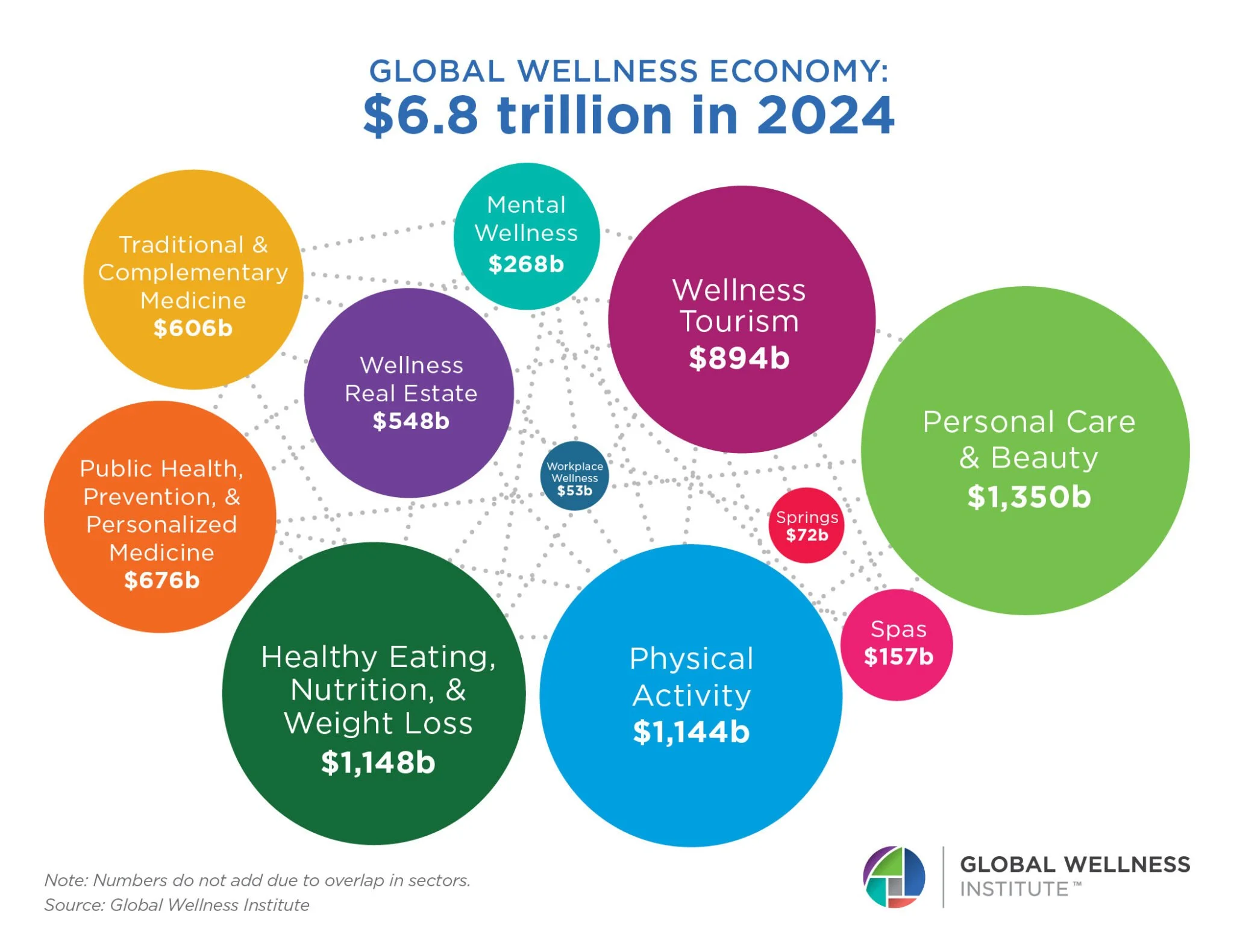
Global Wellness Institute, Global Wellness Economy: $6.8 trillion in 2024. Global spending on wellness has been expanding for all but workplace wellness.
📊 Data That Matters: Use, Perception, and Benefits
Workplace wellness programs are now widespread. According to the KFF Employer Health Benefits 2024 Annual Survey, 54% of employers with 50 or more employees offer wellness programs, a number that has remained relatively steady for the past decade.
These programs are often designed with two goals in mind:
Improve employee health
Reduce healthcare costs for employers
The research on these programs is mixed:
A 2010 study published inHealth Affairs found that for every dollar spent on wellness programs, medical costs fell by about $3.27 and absenteeism costs fell by about $2.73.
A 2014RAND Corporation analysis found that while employees are more likely to participate in lifestyle management programs, most cost savings come from disease management programs.
A randomized clinical trial published inJAMA found that workplace wellness programs improved some health behaviors but did not significantly improve clinical health outcomes such as blood pressure, cholesterol levels, or body mass index.
Participation is another challenge. According to Gartner’s EVP Benchmarking Survey, 87% of employees have access to well-being programs, but only 23% actually use them.
There's also a disconnect in perception: while 81% of employers say that employee health and wellness is important to their organizations, only 24% of employees say that their organization cares about their wellbeing.
In other words: the programs exist, but they aren’t solving the problem.
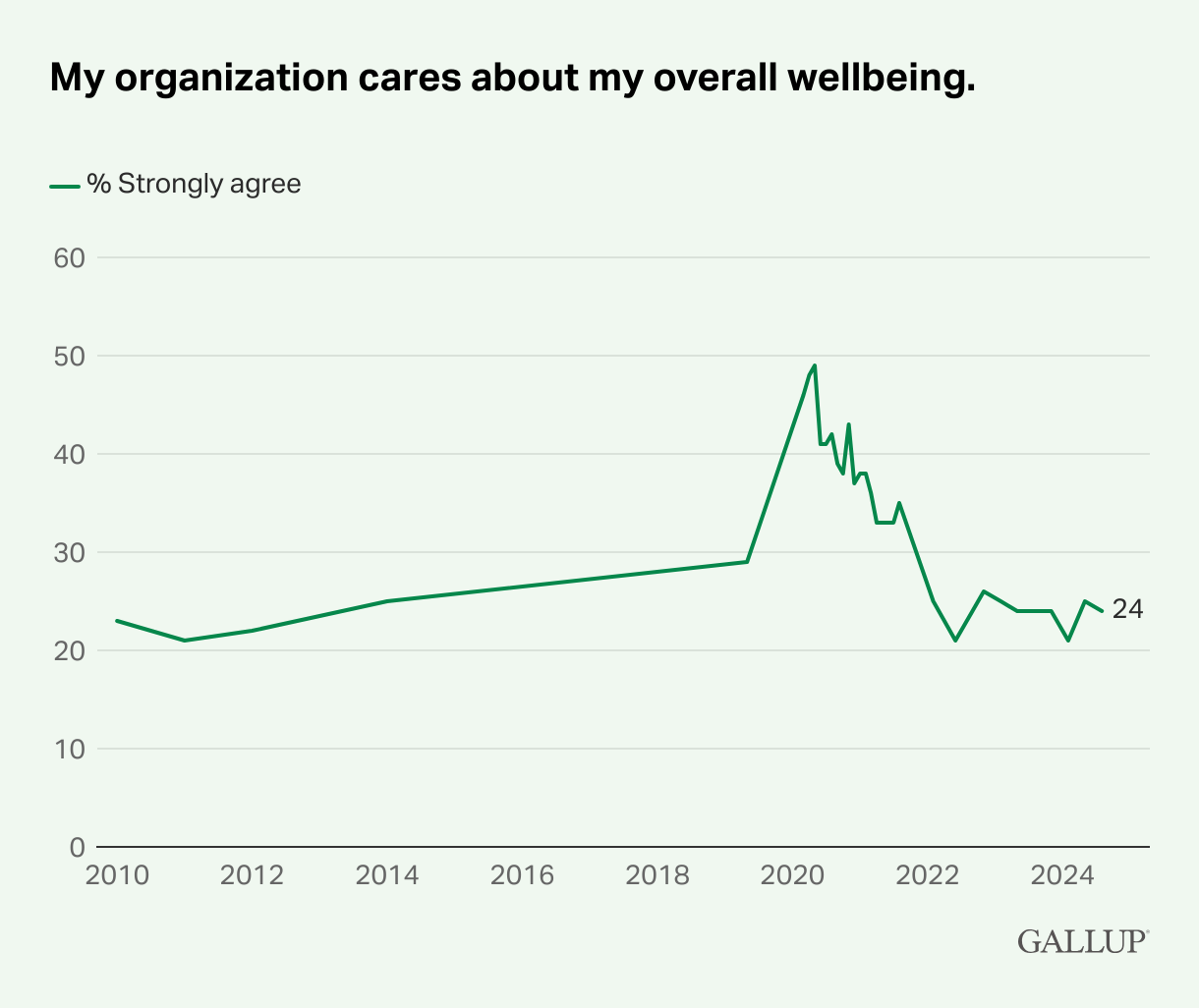
Gallup, Percentage of employees who agree with the statement, “My organization cares about my overall wellbeing.”
⚖️ Equity & Inclusion: The Need for Tailored Programs
Wellness programs are not experienced equally across the workforce.
Close to one-third (30%) of workers said they feel their workplace does not support them because of an aspect of their identity, such as race/ethnicity, gender, sexual orientation, ability status, age, etc. This was worse young workers (18-25), Black and Hispanic workers, and LGBTQ+ workers (APA 2023 Work in America survey).
Programs that support women in the workplace are being scaled back, including flexible working hours and remote/hybrid work options and resources dedicated to supporting diversity and inclusion (Women in the Workplace 2025).
LGBTQ+ employees were less likely to rate their work/life balance as good or very good, gave lower ratings to employer efforts to help improve aspects of wellbeing, and were less trustful than non-LGBTQ+ workers in institutions that provide various employee benefits (EBRI, 2022 Workplace Wellness Survey).
In short: programs designed for a generic employee often fail to reach the employees who may need them most. It is important that organizations tailor their offerings to the needs of their workforce.
🔲 Boundary Highlight: When the Workplace is the Problem
If workplace wellness programs are going to work, they must support the boundaries that make healthy work possible.
Four boundary domains show up repeatedly in research on worker well-being:
Mental boundaries: Psychological safety, workload expectations, and burnout prevention.
Time boundaries: Reasonable hours, flexibility, and the ability to disconnect.
Physical boundaries: Safe working conditions, rest, and access to healthcare.
Financial boundaries: Fair wages, stable employment, and benefits that support real life.
Many wellness programs provide support in these areas. But if the workplace itself violates those boundaries, the program cannot compensate for it.
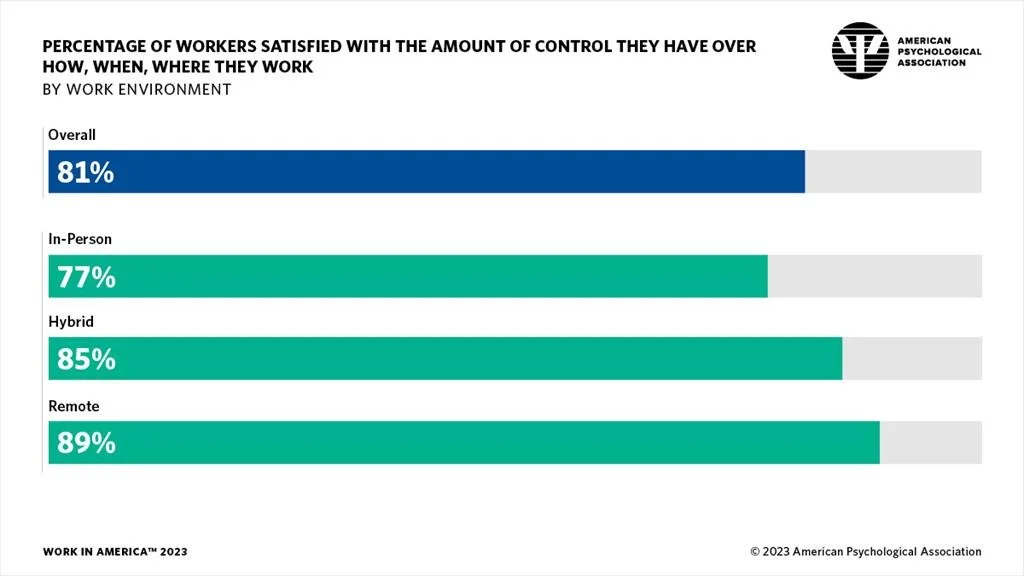
American Psychological Association, Percentage of workers satisfied with the amount of control they have over how, when, where they work, by work environment.
🧾Law & Policy: Protecting Our Health Information
Several federal laws shape how workplace wellness programs operate in the United States:
Affordable Care Act (ACA): Encourages employers to offer wellness programs and allows incentives for participation, while limiting penalties tied to health outcomes.
Americans with Disabilities Act (ADA): Requires wellness programs to be voluntary and accessible to employees with disabilities.
Genetic Information Nondiscrimination Act (GINA): Restricts the collection and use of genetic information in wellness programs. Florida also has a unique protection worth noting: it is currently the only state with a law prohibiting genetic discrimination in life, long-term care, and disability insurance.
Health Insurance Portability and Accountability Act (HIPAA): Protects the privacy of health data collected through wellness initiatives.
Insurance companies also influence wellness program design. Many partner with employers to provide wellness initiatives and may offer premium discounts for organizations that adopt certain programs.
Workplace wellness programs can be less effective or underutilized by minoritized groups due to barriers like accessibility, cultural relevance, distrust, or job security concerns. Employers can address these disparities by creating more inclusive programs that are culturally sensitive, accessible to diverse employees, and address the unique stressors that affect these groups.

Journal of Occupational and Environmental Medicine, Why don’t employees participate in well-being programs?
✅Actions You Can Take: Make Wellness Programs Meaningful
🧠Individual
Use your benefits. Whether it’s physical, mental, or financial wellness, seek out programs offered by your employer and take advantage of what suits you.
Advocate for more inclusive wellness offerings. If your workplace wellness program doesn’t seem to meet the needs of all employees, advocate for a more holistic and personalized approach.
🏢Organizational
Invest in holistic wellness. Go beyond the traditional wellness program and offer services that address mental health, financial stress, and work-life balance.
Make wellness programs accessible and voluntary. Ensure that your wellness initiatives are easy to access, inclusive, and truly voluntary for all employees.
Involve employees in implementation and design. Employees feel a greater sense of belonging and engagement when they are included in decisions that impact them.
Fix work, not just workers by addressing workload, staffing, leadership practices, and psychological safety.
🌍Systemic
Support laws that protect workplace wellness. Ensure employee privacy and accessibility in workplace wellness programs while encouraging innovation in program design.
Support policies that make healthy work possible. Policies like paid family and medical leave, predictable scheduling laws, and protections against excessive overtime create the structural conditions that allow workers to maintain physical and mental well-being.
Expand access to healthcare beyond employment In the United States, access to healthcare is still largely tied to employment. Expanding access to affordable healthcare outside employer-sponsored insurance can reduce economic insecurity and ensure workers can prioritize health even during job transitions.
Closing Reflection
Workplace wellness programs have evolved dramatically since their early focus on smoking cessation and fitness challenges. But the most important shift still lies ahead. Today, the evidence is clear that employee well-being is a performance strategy.
Research from Gallup shows that when employees strongly agree their organization cares about their overall well-being, they are:
• 4.4 times more likely to be engaged at work
• 7 times more likely to recommend their organization as a great place to work
• 73% less likely to experience frequent burnout
• 53% less likely to be looking for another job
• 50% more likely to be thriving in life
Those outcomes don’t come from step challenges or meditation apps alone. They come from workplaces where leaders are willing to address the systems that shape how work actually happens.
Organizations perform best when their people can thrive, and that requires aligning policies, leadership practices, and workplace culture with the reality that work should support life, not consume it.