
The Loneliness Epidemic at Work (And Why It’s Not Just Personal)
I am one of those people who loves remote work and hates return-to-office mandates. But I also love connecting with other people. I firmly believe that you can have meaningful interactions completely virtually. I have many people who are friends and colleagues whom I've only seen in person at the occasional conference. When I think of what made that possible, it's the time to connect before diving into content, the silly icebreaker, the virtual happy hours, and the meetings with no purpose other than connection.
At the same time, I joined a co-working space one year ago. There were many factors in the decision, but one of them was the desire to connect with other humans. Not because we might come up with some new innovative idea or project (a lame reason leaders often give to justify being in the office), but because it's nice to meet other people. And connection is an important factor in what makes us well.
While we have focused on all the ways work has evolved to include remote options, flexible schedules, and digital tools, we’ve quietly let go of something essential: human connection.
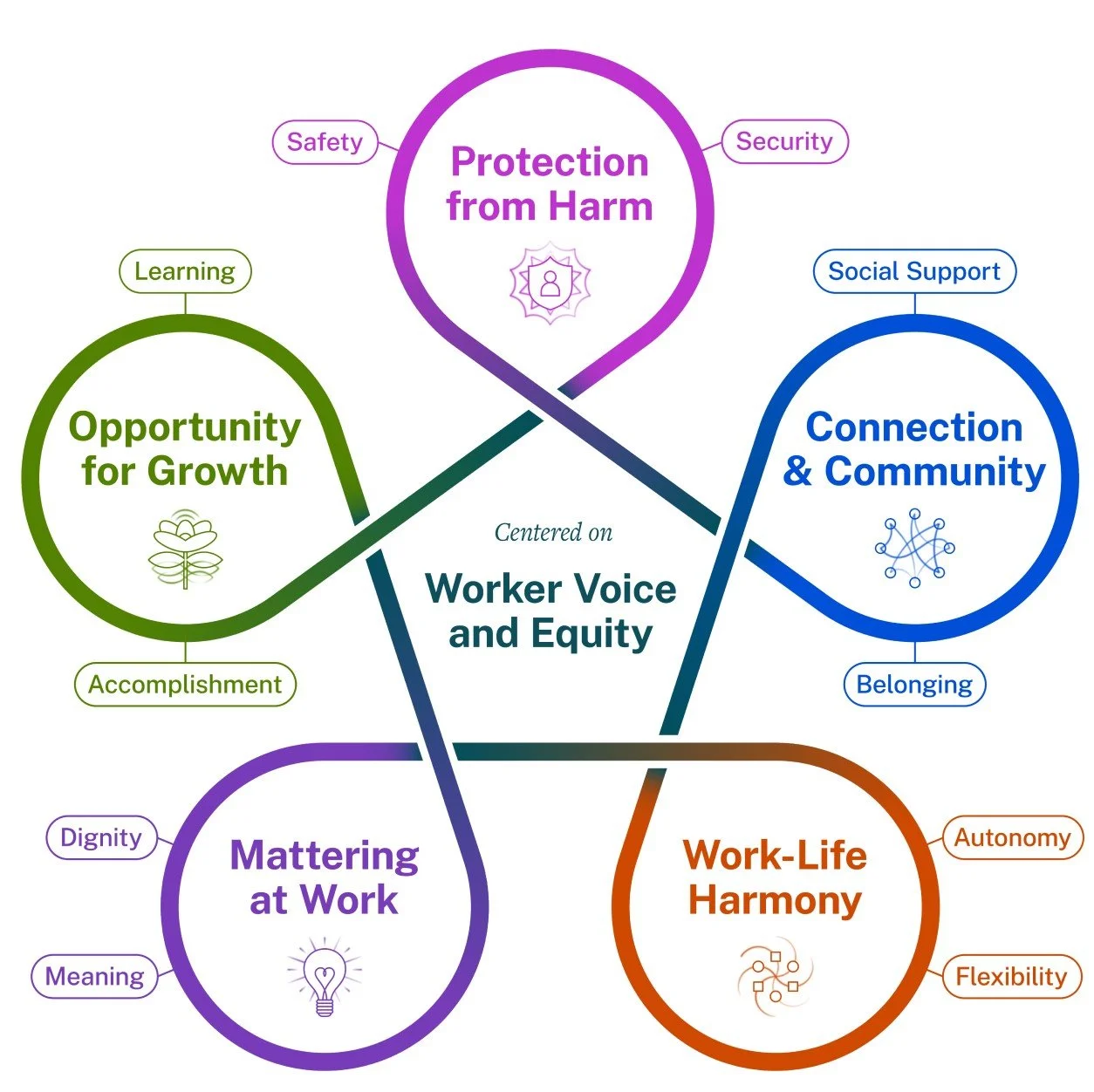
U.S. Surgeon General's Framework for Workplace Mental Health & Wellbeing
And we’re seeing the cost. I often cite the U.S. Surgeon General's Framework for Workplace Mental Health & Wellbeing, which identifies Connection & Community as essential to worker wellbeing as meeting our human needs for belonging and social support.
But former U.S. Surgeon General Dr. Vivek Murthy also issued a report calling loneliness and social isolation a public health crisis, with the risk of premature death comparable to smoking 15 cigarettes a day.
We spend about one-third of our lives (about 90,000 hours) at work. So it's important that workplaces foster connection, both because it helps us to thrive as individuals and because it helps us to thrive collectively by combatting the loneliness and social isolation that modern work has helped to reinforce.
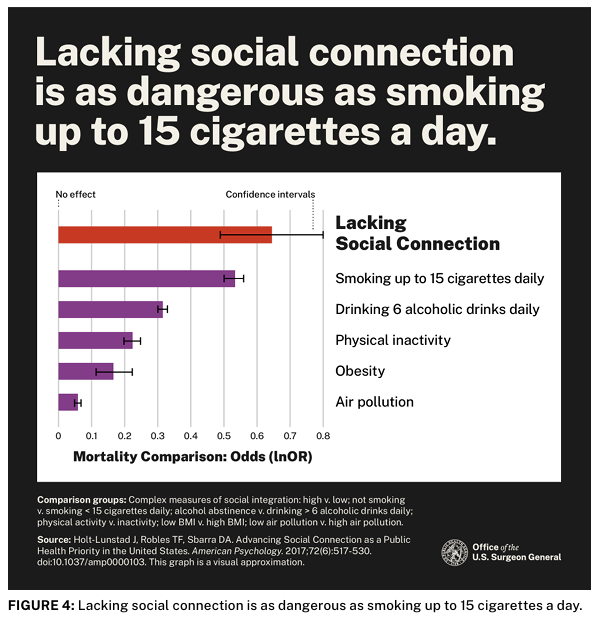
Our Epidemic of Loneliness and Isolation: The U.S. Surgeon General's Advisory on the Healing Effects of Social Connection and Community
📊 Data That Matters: The Loneliness Landscape
The report Our Epidemic of Loneliness and Isolation found that about 1 in 2 adults in the U.S. report experiencing loneliness.
Gallup reports that employees who feel lonely are significantly less engaged and more likely to be actively disengaged at work.
A Pew Research Center study found that 53% of those who work from home at least some of the time say working from home hurts their ability to feel connected with co-workers, while only 10% say it helps them feel connected.
Research from Harvard Graduate School of Education shows that 44% of young adults reported a sense of not mattering to others and 34% reported loneliness, highlighting broader social disconnection trends beyond the workplace.
But there's a bright side: work itself decreases loneliness, and this effect is stronger when employee engagement is higher.
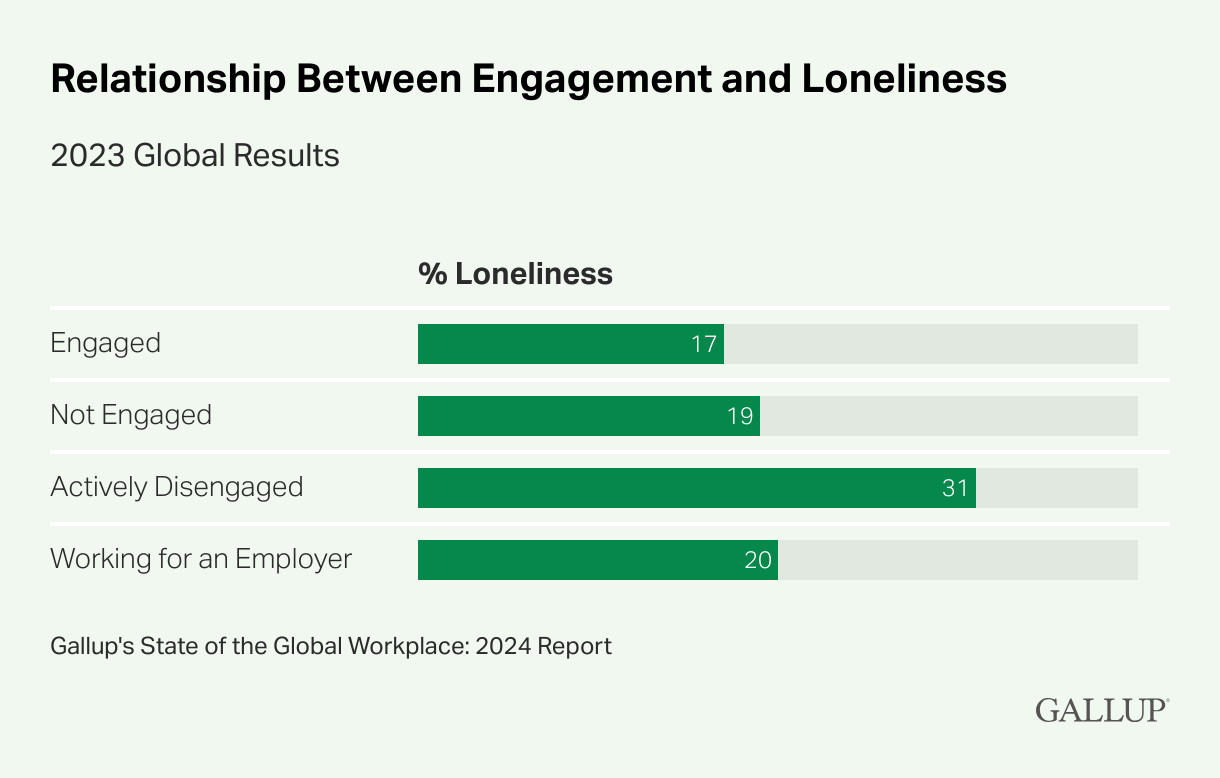
Gallup State of the Global Workplace 2024
⚖️ Equity & Inclusion: Loneliness is Not Equal
Loneliness is not just an individual experience. It is shaped by power, access, and workplace design.
People who are the "only" - woman, person of color, or LGBTQ employee - feel pressured to perform, on guard, and left out. Lean In, Women in the Workplace (multiple years).
The National Study of Caregiving found that about 12% of caregivers (2.8 million) were socially isolated and 27% (6.3 million) were lonely. According to SHRM, 20% of working caregivers have been treated poorly at work because of their caregiving responsibilities, and 22% say there is a negative stigma around being a caregiver at their organization.
Covering, or downplaying aspects of your identity to fit in with the mainstream, affects all employees, but particularly women, people of color, and employees with disabilities, negatively impacting engagement, productivity, and belonging. Deloitte Insights
Connection is necessary for belonging, safety, and opportunity, and failure to create systems that support connection has a negative impact on individual employee wellbeing as well as the wellbeing of the organization.
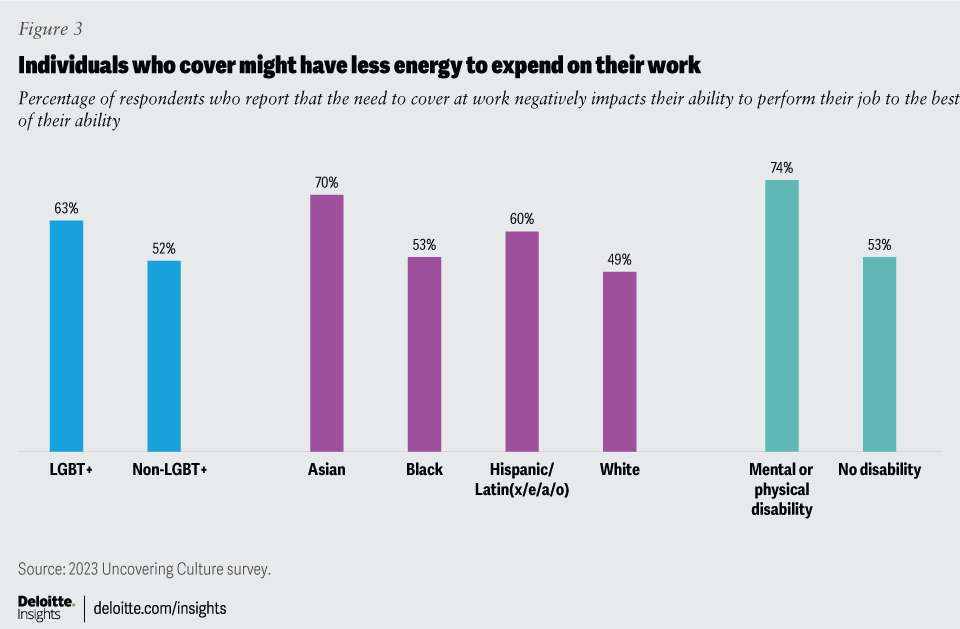
Deloitte Insights, 2023 Uncovering Culture Survey
🔲 Boundary Highlight: The Boundaries of Belonging
I talk a lot about time, energy, and emotional boundaries. It's important that we recognize what we have to give to others (emotional boundaries) and what connections are most aligned and supportive (identity boundaries).
But for the loneliness epidemic to truly be addressed, we need to be asking questions at the organizational and systems levels. How is your organization:
Making intentional space for relationships (not just productivity)?
Recognizing when the work is replacing or even undermining community?
Designing environments where connection is possible and nurtured?
Providing inclusive supports for employees whose experience of work may be different than the dominant culture?
Cultivating leaders who build trust and psychological safety and not just performance?
You can’t expect people to “set boundaries” that protect connection if the system is designed to isolate them.
🧾 Law & Policy: Where Systems Are (and Aren’t) Responding
Data, evidence, and reports only matter if we care about that knowledge and act on it. We know the prevalence and impact of loneliness, yet are still seeing workplaces pushing for operations-first (or process-first) rather than people-first approaches.
People-first approaches include:
Governments and regulatory bodies could require organizations to assess the relational impact of workplace policies, not just productivity outcomes. This includes evaluating how remote, hybrid, scheduling, and workload policies affect trust, belonging, and social connection over time.
Employee engagement programs that are staff-informed and supported by leadership.
Recognition of relationship‑building as a legitimate and necessary component of work. This could include protections or guidance around meeting design, collaboration time, mentoring, and onboarding practices that prioritize human connection along with task completion.
Treating social disconnection as a structural issue requiring coordinated policy response at the highest levels. One example is the U.K. and Japan appointing Ministers of Loneliness.
Policy sets the conditions for our work lives, but policy alone does not create connection. While leaders and institutions must take responsibility for designing environments that don’t isolate people, change also shows up in everyday practice.
We have to ask, within imperfect systems, what can we intentionally do now to rebuild connection…and stop pretending the burden should rest on individuals alone?
VIDEO: Sarah Kay performs "The Minister of Loneliness," a heartwarming poem imagining what life would look like if homes were connected with tin-can telephone strings, creating a universe of curiosity, joy and connection.
✅ Actions You Can Take
🧠Individual: Rebuild Connection Intentionally
Identify one relationship at work to invest in beyond task-based interaction
Protect time for connection the same way you protect deadlines
Ask better questions: How are you…really? (and then be an active listener!).
🏢Organizational: Design for Connection (Not Just Efficiency)
Build connection into workflows (not just optional team-building)
Train leaders to model relational behaviors
Evaluate policies (especially remote/hybrid) through a connection lens
🌍Systemic: Expand the Definition of Workplace Health
Advocate the adoption and implementation of workplace wellbeing frameworks that include social connection
Integrate connection into employee engagement and retention strategies
Support community-based infrastructure that exists outside of work
Closing Reflection: Work Is Third, But Connection Is Foundational
If work is third, then what comes before it matters. Community. Relationships. Belonging. Remember that loneliness is produced by systems, which means it can also be prevented by them.
When social disconnection is baked into how work is designed, intention alone is not enough. Awareness matters. Actions matter. And how we choose to invest in connection, person by person and team by team, can either reinforce isolation or quietly resist it.
The question, then, is not whether connection matters, but how willing we are to act as if it does.