
Job Loss, Mental Health, and the Myth of Stability at Work
When I left my job at the end of 2023, the scariest part wasn't leaving, it was the absence of a safety net.
For most of my career, I have been a public servant, and I came to rely on what that means: a paycheck, health insurance, and a sense of predictability. Walking away without another job lined up raised so many questions and anxieties about what our life would look like. But I also knew that staying in a toxic situation was no longer an option.
I spent many hours pondering questions with no easy answers:
What do we do about health insurance?
How do we manage household expenses with a significant change in income?
What does this shift mean not just for me, but for my husband and our shared future?
I had chosen entrepreneurship intentionally, but intention doesn’t erase risk. What I learned, both then and across many conversations since, is this: our workforce is designed for employers, not employees. We need to work for income, purpose, connection, and survival, but the tradeoff is often paid in physical, mental, and emotional wellbeing.
And when work disappears, so does much more than a paycheck.
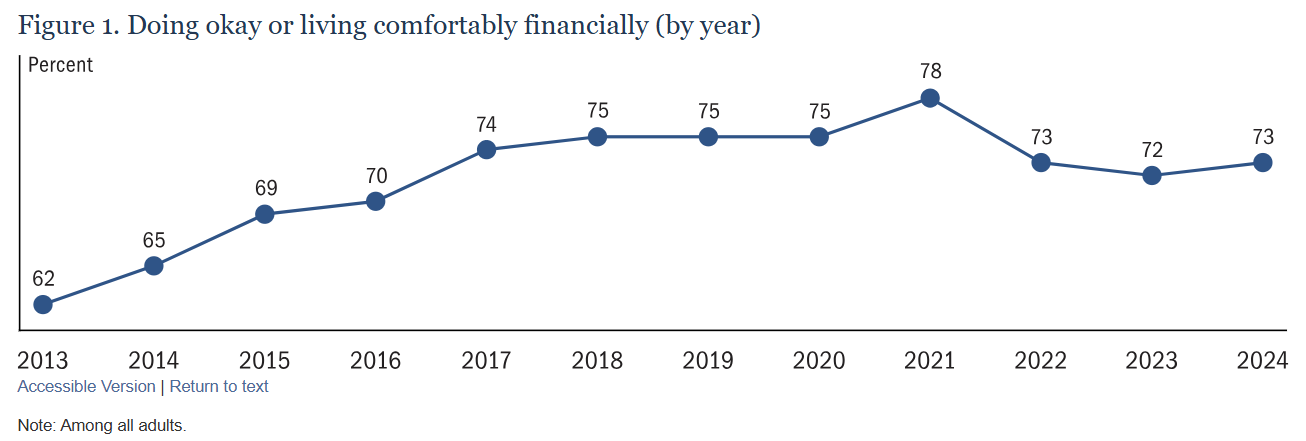
Figure 1. Doing okay or living comfortably financially (by year). Report on the Economic Well-Being of U.S. Households in 2024 - May 2025
📊 Data That Matters: Unemployment Is a Health Issue
Economic stability is one of the most powerful social determinants of health, and unemployment disrupts it at every level. According to a study in the American Journal of Industrial Medicine:
More than one third of people who are short-term unemployed reported lacking health insurance (34.8%), did not have a primary care provider (41.4%), and reported not being able to afford care due to cost (30.3%).
Reported fair or poor general health was highest for the short-term unemployed (22.5%), the long-term unemployed (32.7%), and those unable to work (61.6%).
These same three groups had a higher prevalence of poor physical and mental health, including higher prevalence of depression and hypertension.
In January 2026, U.S. employers announced 108,435 job cuts, a 118% increase from a year earlier and the highest January total since 2009, largely driven by the transportation and technology sectors due to factors like AI-related restructuring and changes in consumer demand. → USA Today, Job cuts are highest for any January since 2009. See why.
Job loss is associated with increased rates of depression, anxiety, substance use, and chronic stress (American Psychological Association) and periods of unemployment can have lasting health effects, even after reemployment.
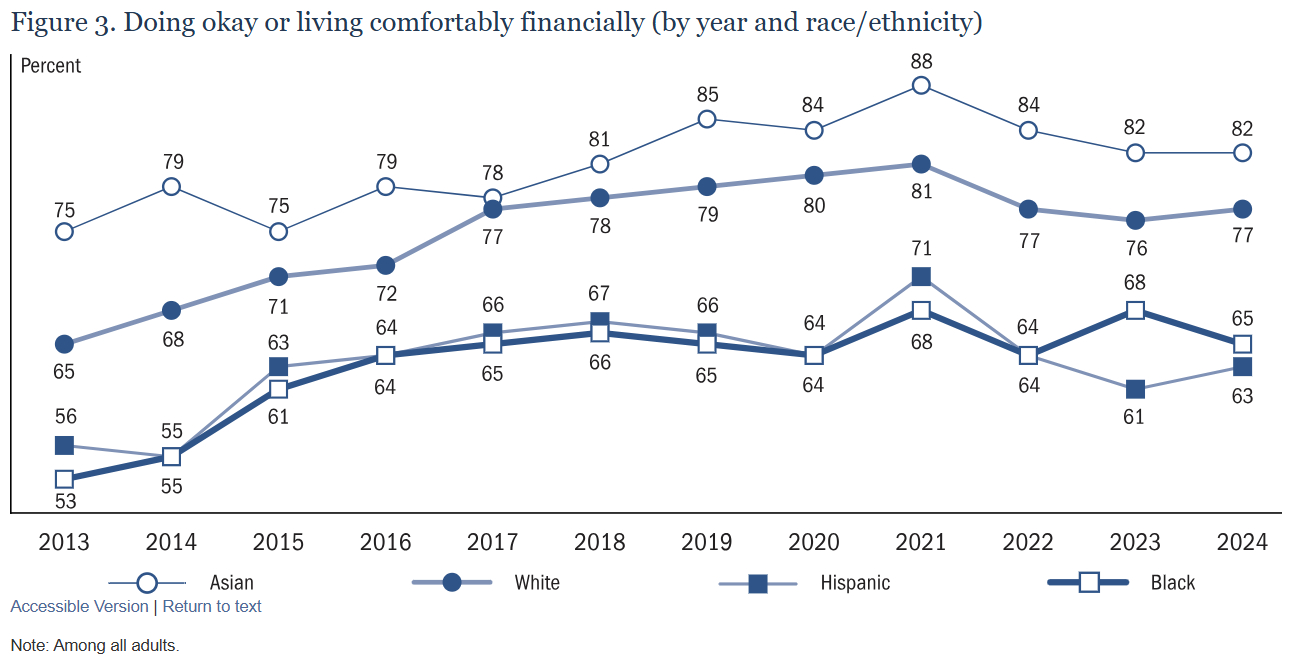
Figure 3. Doing okay or living comfortably financially (by year and race/ethnicity). Report on the Economic Well-Being of U.S. Households in 2024 - May 2025.
⚖️ Equity & Inclusion: Who Bears the Risk
The burden of recent job losses is not evenly shared. Black women, people with disabilities, caregivers, and workers with lower education are disproportionately affected, often cycling between unstable work, underemployment, and entrepreneurship not by choice, but by necessity.
An estimated 300,000 Black women exited or were displaced from the workforce in 2025, and have an unemployment rate of 6%, which is nearly double that of white workers and significantly higher than white women. A critical driver of this trend has been government layoffs.
→ African American Alliance of CDFI CEOs, The Rising Unemployment Rate Among Black Workers: A Warning Sign of Broader Economic InstabilityPeople with disabilities are significantly more likely to be self-employed or entrepreneurs and continue to experience employment barriers that intersect with race and ethnicity. For example, 68.1% of people without disabilities are in the labor force, this number is significantly lower for white people with disabilities (24.4%), Black people with disabilities (23.3%), Asian American people with disabilities (18.5%), and Hispanic or Latino people with disabilities (26.7%).
→ National Partnership for Women & Families, Disabled employment is at a record high, but disparities remainSix out of ten caregivers (61%) are more likely to experience at least one change in their employment due to caregiving, like cutting back on work hours or receiving a warning about performance or attendance, while 49% of caregivers arrive to their place of work late, leave early, or take time off.
→ Family Caregiver Alliance, Caregiver Statistics: Work and Caregiving
These patterns aren’t accidental. They reflect a system that was not designed to be inclusive, flexible, or to support the opportunity for meaningful employment for all. I call attention to this data because economic instability compounds existing inequities, making unemployment not just a labor issue, but a public health and justice issue.
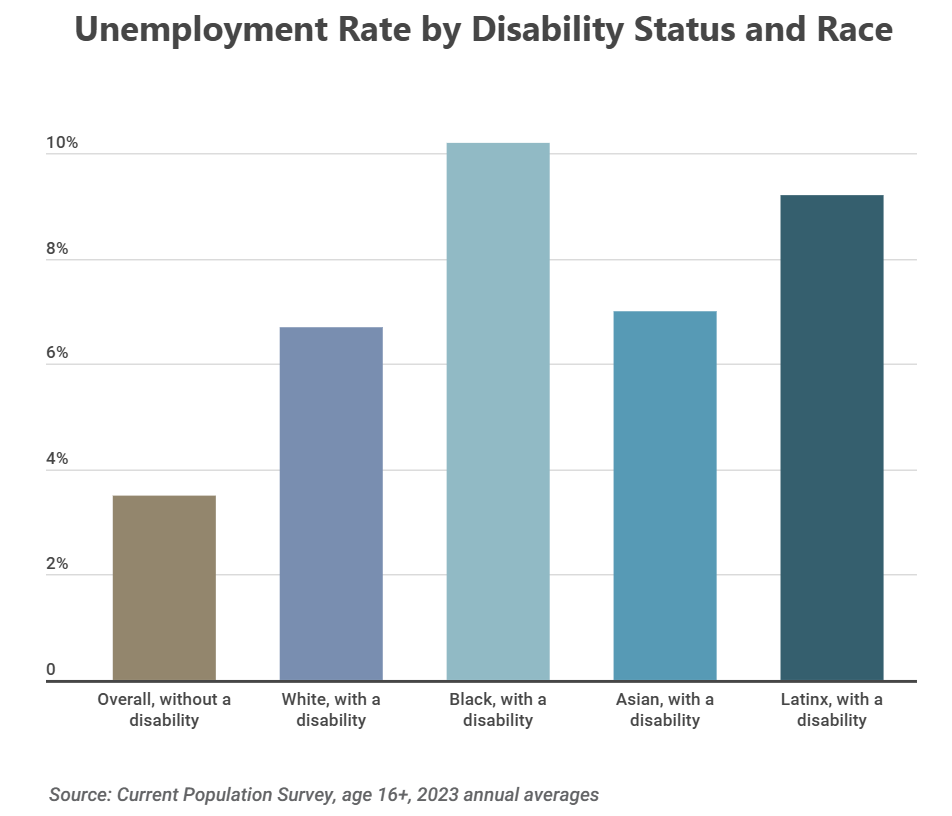
Unemployment rate by disability status and race.
🔲 Boundary Highlight: Work ≠ Worth
One of the most important boundaries we’re taught to violate is the one between who we are and how we earn. This is a frequent topic on the Work is Third podcast.
Unemployment challenges identity. It can trigger shame, fear, and self-blame, even when job loss is structural, not personal. Healthy boundaries require reframing:
Your value does not disappear when your job does
Stability should not be a privilege reserved for the “right” kind of worker
Rest, care, and dignity are not rewards for productivity
Systems have to be designed to support workers, so that boundaries are part of a healthy lifestyle, and not just survival tools.
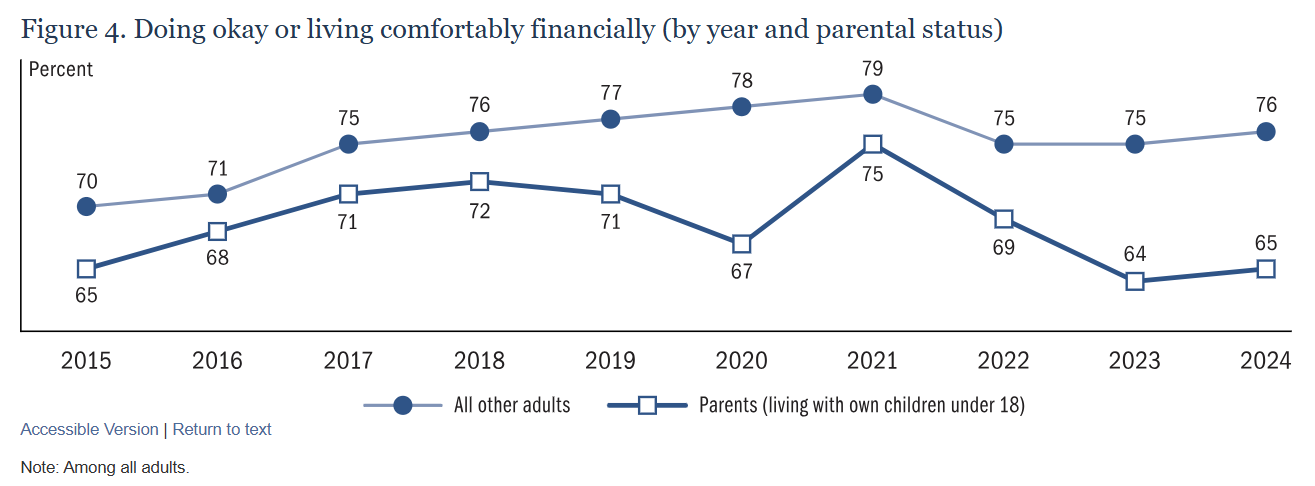
Figure 4. Doing okay or living comfortably financially (by year and parental status). Report on the Economic Well-Being of U.S. Households in 2024 - May 2025.
🧾Law & Policy: Why the System Feels So Fragile
Much of our instability is baked into policy design.
Health insurance is still largely tied to employment, making job loss a risk to physical and mental health
Unemployment benefits are often insufficient, difficult to access, or time-limited
Workplace protections rarely account for caregiving, disability, or mental health realities
Entrepreneurship is celebrated rhetorically, but poorly supported structurally
The result? Workers absorb risk that institutions and employers are unwilling to hold. But we can design better systems, starting with establishing shared values that healthcare is a human right, workers deserve a living wage, everyone should have the opportunity to find employment that fits who they are, and that flexibility is necessary to ensure that workers with a variety of backgrounds, experiences, and conditions are supported.
✅Actions You Can Take: What Can Change
🧠Individual
Acknowledge the grief and stress of job loss. It’s real, even when the decision is voluntary. You don't have to solution your way out of your feelings.
Separate self-worth from employment status by making sure you have other hobbies and activities and a robust support system (friends, family, found family).
Seek community support. Isolation makes instability heavier.
🏢Organizational
Create a culture that values people by recognizing the realities of life (like being a caregiver or having a disability) and designing inclusive workplaces.
Ensure your employees are paid a living wage.
Increase employee engagement by offering meaningful perks that support employee wellbeing - including economic wellbeing.
🌍Systemic
Expand access to affordable healthcare regardless of employment.
Strengthen unemployment protections and income supports.
Treat economic stability as a public health priority, for example, by investing in skills development and pipeline programs and making education more accessible.
Closing Reflection
Work is a cornerstone of stability. But for many people, work is the source of instability.
If we want healthier individuals, families, and communities, we must stop pretending that employment alone is protection. Economic security is health infrastructure. And until we design systems that honor that truth, boundaries will remain one of the few tools workers have to protect themselves.